
Why people write books is probably the most important part of any conversation we have with an author, so let me spend a minute on it. This is, quite frankly, everything behind your book.
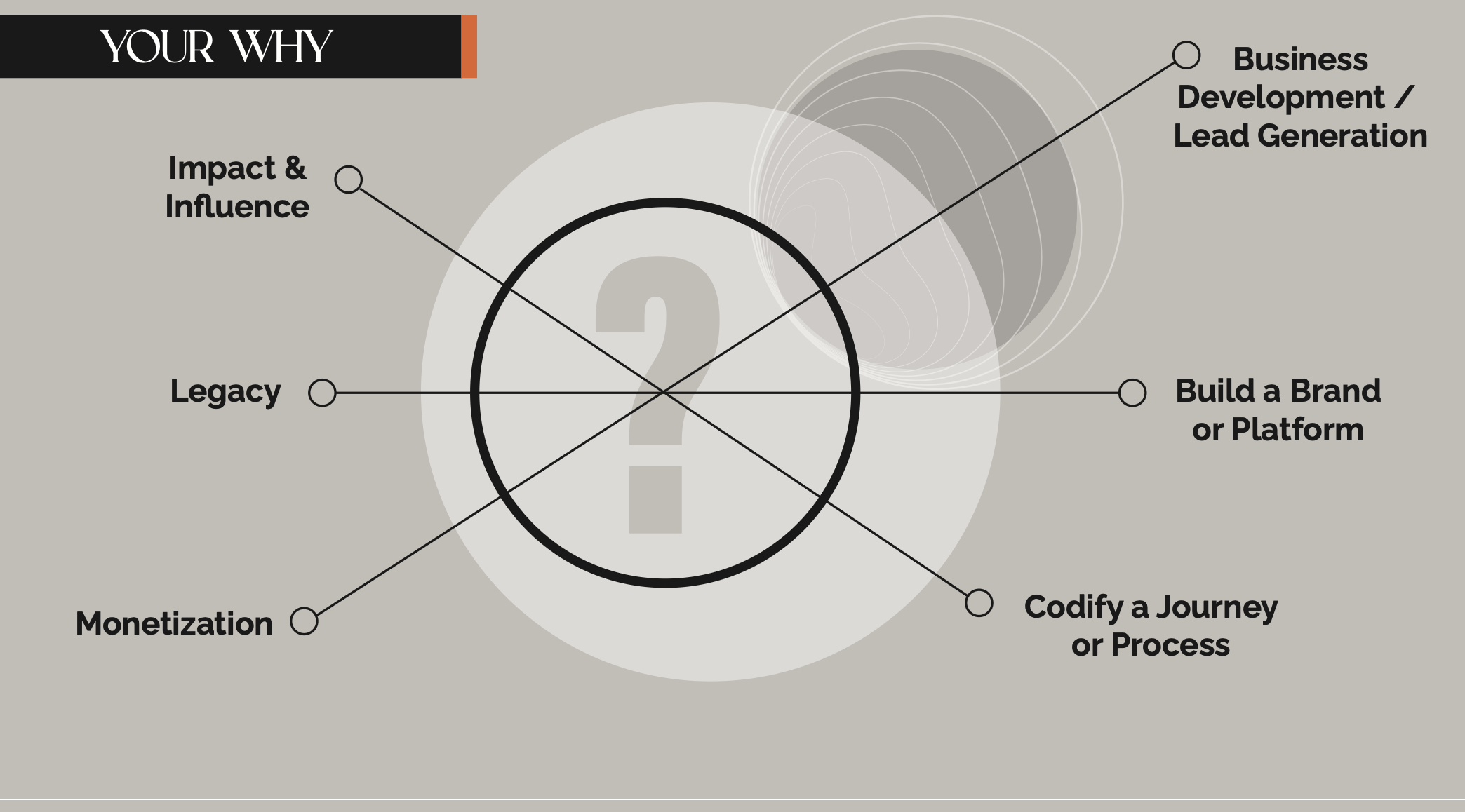
There are six reasons to write a book. There are probably more, but we have narrowed it down to six: impact and influence; legacy; monetization; business development and lead generation; building a brand or platform; and codifying a journey or process.
I like to think about all six in terms of ROI, in two different ways: Return on Investment and Return on Impact.
When we meet with an author, it does not matter where they are in their writing journey; we ask about both. Have you defined what your Return on Investment will be for bringing this book to market? Because there will be a cost, no matter which publishing path you choose, you will spend somewhere between $5,000 and $100,000 (or more) to bring a well written, well published book to market. More importantly, what is your Return on Impact? What do you want the book to do for the reader? When they finish reading it, what is their next step? How do you want them to apply it to their life, their team, or their organization? What is the transformation that you want to see happen in their life, or in the world?
Most authors can answer the first question, but very few have ever been asked the second one.
“What is the ROI of your book? Not just the Return on Investment, but the Return on Impact?”
Davin Salvagno, Bestselling Author of Thieves of Purpose, Cofounder of Maison Vero Publishing
When you run the six reasons back through the lens of ROI, they come into focus.
Impact and influence are the return-on-impact question from end to end: what do you want this to do for your reader? Legacy runs the other direction: what do you want it to do for you? Sometimes a person simply has a book in them, and it is a bucket-list item. There is a piece of them they want to leave in this world long after they are gone. For others, the book is part of a plan or a resource for something more, which these next whys will cover.
Monetization is a question underneath a question. What is it you are actually monetizing? Speaking? Coaching? Consulting? A program? Many of our authors use the book as a business-development tool, the tip of the spear, and they are strategic about whom they put it in front of, because every copy is meant to start a conversation that leads to a deeper relationship.
Building a brand or platform is the one people are least clear on. There are a lot of people trying to reinvent themselves and step into the arena as a thought leader, speaker, or coach, but the space is extremely noisy, and they don’t know how to break through the noise. They spent an entire career as an employee, or tied to something else, and now they need the book to legitimize the new persona to brand them as a subject-matter expert. For this author, inviting their reader to their writing journey and transformation is essential for their success.
Finally, codifying a journey or process may be the most durable of the six. You could be running a company and transitioning out of it, wanting to keep the culture you built alive long after you are gone. Your book becomes a playbook or blueprint for the leaders coming behind you, to help them ensure what you built lasts.
No matter what your why is, what is most important is that you write the book that you were meant to write. So many authors start with a clear message with what their book is about and why they are writing it, and then they begin to drift. They start with the thing they know, watch what everyone else in their category is doing, and then slowly write somebody else’s book. Nobody decides to drift, but all too often their voice gets lost because they are trying to sound like someone else. No one has the same exact why as you do. Someone somewhere is waiting to read your book, in your voice, in only the way you can write it.